
People are not just tired. Many are dysregulated.
That may sound like a clinical word, but its effects are painfully human. We see it in children who are constantly overstimulated, in parents who are mentally loaded, in caregivers who are running on emotional fumes, and in families who are physically together but emotionally scattered. We live in a time where many people appear functional on the outside, yet inside they are carrying noise, fatigue, and quiet distress. This is not merely modern busyness. It is a silent psychological emergency.
Today’s world offers families endless stimulation. There are malls, screens, bright lights, fast entertainment, constant notifications, quick distractions, and an almost unlimited supply of things to consume. But stimulation is not the same as restoration. Occupation is not the same as regulation. Many spaces know how to entertain people, but very few know how to help them slow down, soften, and reconnect. That is where the real problem begins. A child who is always overstimulated may struggle to settle, connect, and focus. A parent who is always overloaded may be present in body but absent in spirit. A family that never experiences calm together may gradually lose the rhythm of genuine connection.
This is the deeper reason Butik Roti Maria exists.
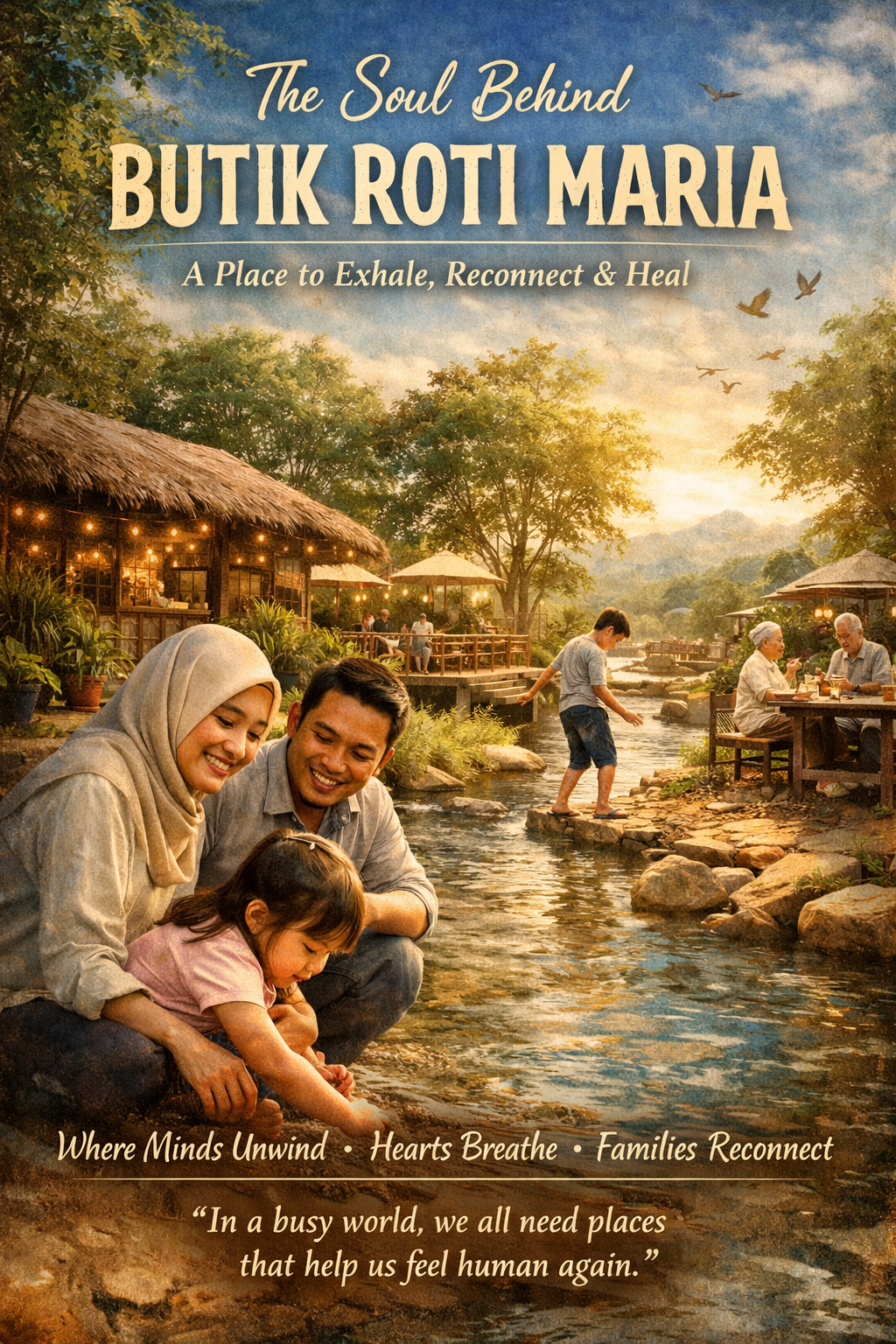
At one level, Butik Roti Maria is a family-run riverside kitchen and event space rooted in more than 30 years of food heritage. It serves artisan food, welcomes families, hosts gatherings, and offers a unique setting by a small sandy riverside stream. But the soul behind Butik Roti Maria goes beyond food and hospitality. It is built around a more urgent human need: the need for regulation, reconnection, and relief.
Butik Roti Maria was not designed merely as a venue. It was built as a therapeutic eco-sensory space where the environment itself becomes part of the healing experience. Here, guests do not only come to dine. They come into contact with a different pace of life. They hear the gentle flow of water. They see greenery, fruit trees, natural light, and open skies. Children can move, explore, and feel the textures of sand and nature beneath their feet. Families can sit together in a space that does not demand performance, speed, or overstimulation. In this kind of environment, the body receives a different message: you can soften here.
That matters more than many people realise.
Healing does not always begin with advice, lectures, or programs. Sometimes it begins with the right environment. The right sound. The right pace. The right table by the riverside. The right moment of stillness. The right meal shared without pressure. At Butik Roti Maria, food is part of the story, but the deeper offering is emotional ease. It is a space where tired minds can loosen, heavy hearts can breathe, and families can reconnect without being forced to manufacture joy.
This is why Butik Roti Maria matters not only to diners, but also to institutions, schools, corporations, and community leaders.
Too often, people are gathered in spaces that are functional but not restorative. Meetings are held in cold rooms. Family days are organised in venues that are visually busy and emotionally flat. Educational and corporate events may be efficient on paper, yet they leave participants just as tired as before. If we continue to choose venues based only on convenience, capacity, or routine, we may achieve attendance, but we may miss transformation.
The environment where people gather affects how they listen, how they learn, how they bond, how they reflect, and how they remember. It shapes the emotional quality of the experience. A conventional venue may host a program, but not every venue can support regulation. Not every venue can soften overstimulation. Not every venue can help families feel present with one another again.
That is why places like Butik Roti Maria are no longer a luxury. They are part of the answer.
For CEOs, COOs, institutions, schools, NGOs, and organisers, the challenge today is no longer simply to create events that are well attended. The real challenge is to create experiences that genuinely support human well-being. If children are overstimulated, if adults are burned out, and if families are disconnected, then our spaces must respond to that reality. We cannot keep asking tired people to reconnect in environments that do not support emotional ease. We cannot keep designing family engagement without understanding the nervous systems of the people we claim to serve.
Butik Roti Maria offers a different possibility. It is a place where artisan food, riverside grounding, natural textures, greenery, and family warmth come together with intention. It is a place that welcomes children, elders, neurodivergent individuals, families, teams, and communities into a more breathable experience. It is not trying to be the loudest place. It is trying to be one of the most meaningful.
The soul behind Butik Roti Maria is simple but powerful. It serves food, but it also serves pause. It hosts events, but it also hosts reconnection. It welcomes guests, but it also creates room for people to feel human again.
In the future, the most valuable spaces may not be the noisiest, trendiest, or most glamorous ones. They may be the spaces that understand how to calm the human soul. The spaces that know how to reduce internal noise. The spaces that remind families, teams, and communities what it feels like to breathe together.
That is the soul behind Butik Roti Maria.
It is more than a place to eat.
It is a place to exhale.